
If you want to improve your site’s rankings, you have to optimize a page’s SEO. Today, we’ll look at how do long URLs affect SEO and URL structure and length.
A URL is a text string that was created to replace the numbers (IP addresses) that computers use to connect with servers. They also identify the website’s file structure. A URL is made up of a protocol, a domain name, and a path (which specifies the precise subdirectory structure where a page is placed) and follows the fundamental format:
protocol://domain-name.top-level-domain/path
A well-crafted URL gives both people and search engines a clear idea of what the destination page will contain. Furthermore, URLs are a small ranking element used by search engines to determine the relevancy of a certain website or resource to a search query. While they do add weight to the overall domain’s authority, keyword inclusion in a URL can also be a ranking factor.

How do long URLs affect SEO?
While appropriate URL structure isn’t the holy grail of SEO efforts, it is feasible that generating SEO-friendly URLs might provide you a ranking advantage over your competition. According to Google Webmaster’s Search Engine Optimization Starter Guide, it is vital to develop descriptive categories and filenames to keep your website more structured, as well as to lead to better crawling by search engines.

This can also result in simpler or friendlier URLs for individuals who want to connect to your material. Aside from providing more information about the website to visitors and search engines than an awkwardly called parameter would, if your URL contains relevant phrases. And, you have to agree, most of the results that queries yield incorporate the necessary keywords in their URL format.
How does Google evaluate URLs?
In a video from the #AskGooglebot series, Google’s John Mueller tackles the topic of whether URL length matters for SEO. He also describes the circumstances in which the URL length may be considered. URLs are considered identifiers by Google, and the length of the URLs is irrelevant. As a personal opinion, John suggests keeping URLs around 1,000 characters. Furthermore, the amount of slashes in URLs appears to have little effect on SEO. Here’s John Mueller’s explanation:
“The direct answer is No, the URL length doesn’t matter. We use URLs as identifiers, it doesn’t matter how long they are. Personally, I try to keep them shorter than 1000 characters, but that’s just to make monitoring easier. The number of slashes in there also doesn’t matter.”

Despite Google’s claim that there is no relationship between URL length and SEO ranking, some research shows otherwise.
How long should a URL be for SEO?
So, do long URLs affect SEO, and if so, how? “Shorter URLs tend to rank higher than lengthy URLs,” according to Backlinko. They conducted rigorous testing on one million Google search results to demonstrate this. The graph below depicts how Google ranks fall as URL length increases.

It’s quite straightforward. Take note of the URLs in the top spot, which has about 50 characters. However, by the tenth position, the average URL contains 62 characters. So anywhere between 50 and 60 characters is a reasonable starting point.
How long can we make a URL without having any impact?
As previously indicated, the sweet spot for a URL is 50 – 60 characters. If you go much over (say, 80+ characters), your rating will very certainly suffer.
URL length limit
When it comes to search engine optimization, the XML sitemap format for sending URLs to search engines is important. The loc> element, which is used to submit URLs, has a maximum length of 2048 characters according to the official documentation:
“URL of the page. This URL must begin with the protocol (e.g. “HTTP”) and end with a trailing slash if required by the web server. This value must not exceed 2,048 characters.”
Longer URLs can render the XML sitemap incorrect, and search engines may discard the sitemap as a result.
What is the structure of a URL?
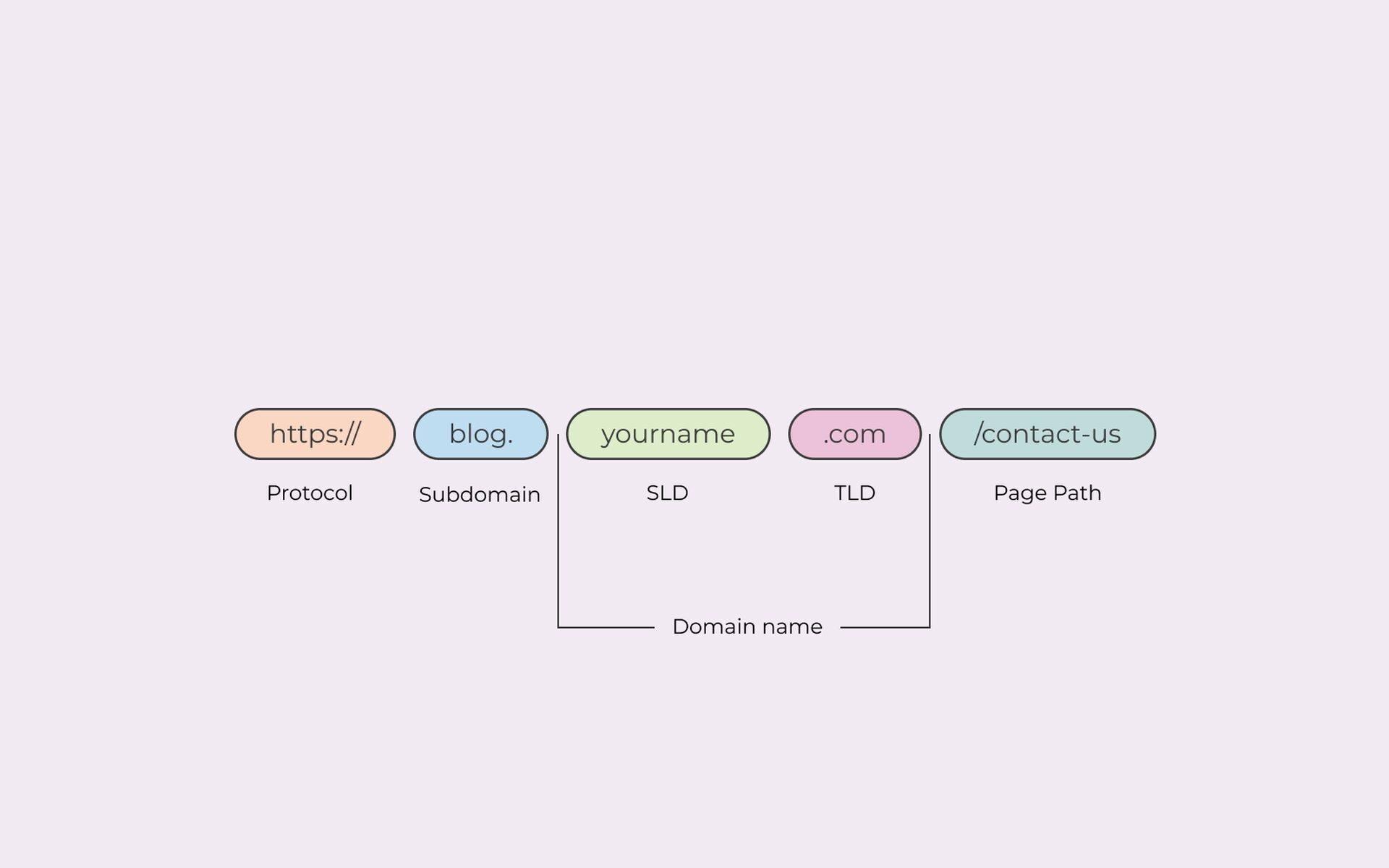
A URL consists of five different parts: the protocol, subdomain, top-level domain, second-level domain, and path.
Protocol
When a web server requests a page on your website, the protocol tells it which protocol to use. Nowadays, HTTPS (Hypertext Transfer Protocol Secure) is the most often used protocol. It instructs your online browser to encrypt any information you submit on the website, such as passwords or credit card numbers so that thieves cannot access it. This security strategy protects your website users and applying it will improve your site’s Google ranking.
Subdomain
If your website is a house, subdomains are individual rooms within that house. A subdomain in a URL specifies which page of your website the web browser should display. Subdomains such as “blog” or “offers” will, for example, supply your website’s blog or offers page. Subdomains also categorize your website’s content and show Google and your visitors that your site has more information than just a homepage.

Second-level domain
Your website’s second-level domain (SLD) is its name. It informs visitors that they are on the website of a specific brand. People who visit “mlb.com,” for example, know they’re on Major League Baseball’s website and don’t need any other information.

Top-level domain
The top-level domain (TLD) identifies the sort of entity that your company registers as on the internet. Because “.com” is meant for commercial companies in the United States, many American firms register with a “.com” top-level domain. Similarly, because “.edu” is meant for academic institutions in the United States, many American schools and universities register with a “.edu” top-level domain.

It is preferable to choose a better TLD, such as “.com,” rather than “.biz,” “.pro,” “.tel,” and so on, for a better URL. We’re not suggesting you’re doomed if you use a domain extension other than “.com.” In truth, TLD has no direct influence on rankings. However, it does seem to build confidence in human users.
Path
A route, also known as a subfolder, assists both humans and web spiders in determining where the area of a webpage they are on. For example, if you have an online business that sells t-shirts, hats, and mugs, one of your URLs may be “https://shop.yourstore.com/hats.” Because the subdomain is “shop” and the route is “hats,” this URL will take you to the “Hats” page, which is a subfolder of the “Shop” website. T-shirts and mugs are also subfolders of this page.

What are SEO-friendly URLs?
SEO-friendly URLs are those that are tailored to the demands of users and search engines. URLs designed for SEO, in particular, are brief and keyword-rich.
How to optimize URL structure SEO?
- It is critical to keep URLs as clear, relevant, appealing, and correct as possible in order for both your users and search engines to comprehend them (a prerequisite to ranking well). Although URLs might include ID numbers and codes, it is ideal to use language that people can understand.
- URLs should be firm yet succinct. A user (and search engine!) should have a clear understanding of what to expect on the page based only on the URL.
- Use hyphens to separate words as necessary for readability. To separate words, URLs should not utilize underscores, spaces, or any other characters.

- Lowercase letters should be used. Uppercase letters might produce duplicate pages in rare circumstances. For example, domain.com/Blog and domain.com/blog might be interpreted as two unique URLs, potentially resulting in duplicate content concerns.
- If possible, avoid using URL parameters because they might cause tracking and duplicate content concerns. If parameters must be used (for example, UTM codes), use them sparingly.
How do you add meta tags to your URL?
You must alter the HTML file’s head> section to add meta tags to a web page. There are two techniques for editing HTML files. If the file is already on your website, you may download it with an FTP client and modify it with your favorite text editor. If you’re making a new file, do it in your text editor. After you’ve made your modifications, save and upload the file. See Downloading and Using FTP Software Programs for further information. You may also use the cPanel File Manager to add or change the file.

Locate the head> section towards the top of the HTML file and open it. There may already be a title and some other metamaterial on the page, depending on how you generated it. The title is enclosed by HTML title>/title> tags. Meta> tags are used to enter the description and keywords. In the code below, for example, we have meta name=”description” and meta name=”keywords.” When I created the page, my HTML editor automatically inserted the meta http-equiv element, which provides the character encoding.
<head>
<meta http-equiv=”Content-Type” content=”text/html; charset=utf-8″>
<title>How to add meta tags to a web page</title>
<meta name=”description” content=”All about meta tags and how to add them to your website.”>
<meta name=”keywords” content=”meta tags, meta description, meta keywords, SEO, search engine optimization”>
</head>

We hope that we were able to shed some light on the topic of how do long URLs affect SEO and how URLs affect SEO in general. If you did find this article useful and want to improve your site further, be sure to check out diagnosing the right SEO strategy is vital for your healthcare business, or enterprise SEO plane will take you to your goal.